
Merced, CA · Garage Door Service
Garage Door Repair for Atwater Homes
Atwater's median home dates to 1979, four years older than the Merced-area norm. That changes which springs, tracks, and openers we bring on the truck for this job.
- Repairs & new doors
- Springs & openers
- Serving 4 nearby communities
What Is on the Truck
Atwater's housing stock runs a median year built of 1979, a few years ahead of the broader Merced service area's 1983 figure. That gap matters more than it sounds. Doors and openers installed in the late 1970s predate a lot of the hardware that's common on trucks stocked for newer construction - wider torsion springs sized for heavier wood-panel doors, galvanized track in the older roll-formed profile, and openers built before today's circuit boards and logic boards became standard. We carry both eras of parts because this area and the rest of the territory don't match up door for door. If your opener is original to a 1979-built house, we're not guessing at what's behind the bracket - we bring stock that fits '70s and early-'80s torsion setups, plus the newer extension and torsion springs that showed up as the area filled in through the '80s and '90s. Rollers matter here too. Nylon rollers on original hardware have had four decades of summer heat to dry out, and that's usually visible before we even open the door - flat spots, cracked flanges, a roller that's gone from round to oval. We check those on every call, not just the ones listed on the work order.
How We Fix It
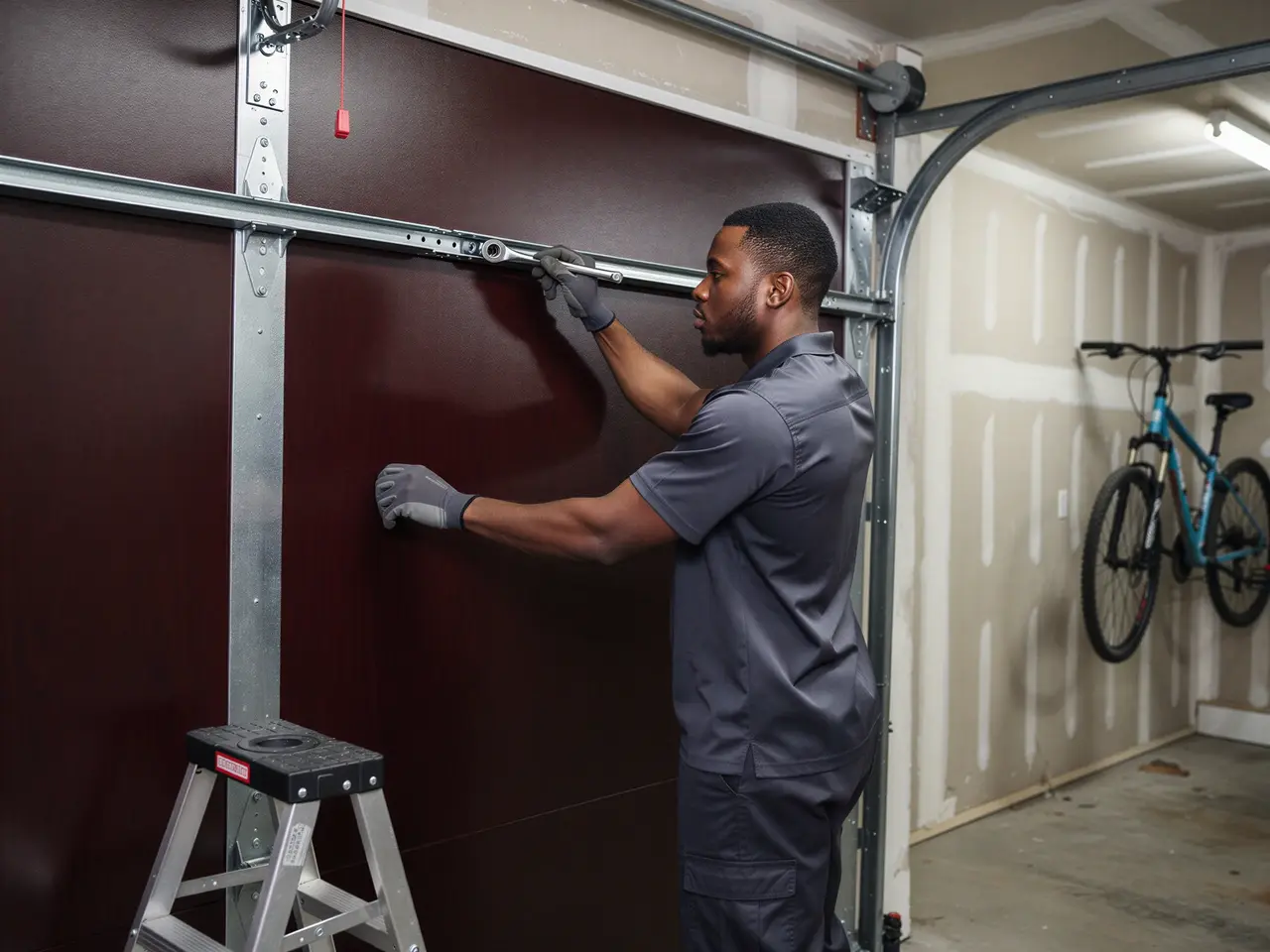
The fix depends on what generation of door we're standing in front of. On original 1970s hardware, a broken torsion spring usually means replacing both springs on the shaft even if only one failed - they wear as a pair, and the other one is close behind. Cable fraying shows up earlier here too, since original cable on older doors is thinner gauge than what's used now. We respool or replace as needed rather than patching a frayed strand, because a cable that's already stretched once won't hold a second time. Track misalignment is common on houses that have settled over forty-plus years - we re-set the track to the jamb rather than just bending it back, since bent track that's been bent back tends to bend again within a season. For openers, if the unit predates modern safety-reversal circuitry, we'll say so plainly and talk about replacement instead of patching an aging board - that's a safety call, not an upsell. On newer stock from the '80s and '90s building wave, the repairs are more routine: roller swaps, sensor realignment, opener logic board resets. We bring what each era needs rather than treating every call the same.
The Cost of This Job
We don't have a posted price list for Atwater calls specifically, and we're not going to invent one here. What we can say is that the age of the hardware drives the cost more than the trip does - a torsion spring swap on a 1979-era door with original brackets takes longer and needs different parts than the same repair on a door installed in 1995, and that shows up in the estimate. Atwater's median household income runs $63,945, a bit above the $61,096 figure for the wider Merced service area, and the housing here skews slightly older than that area's 1983 median build year. Neither number changes what we charge, but together they describe a town where original hardware has had more years to wear out and where replacement parts for that hardware aren't always the cheapest option on the shelf. We'll tell you on site whether a repair is worth doing or whether the door's age means a full replacement actually costs less over the next few years. That's not a sales pitch - it's the honest math on parts that are forty years old.
Can You Do This Yourself
Some of this is fine to handle yourself. Tightening loose hardware, lubricating hinges and rollers, clearing debris from the track - all reasonable weekend jobs, and worth doing regularly given how hard summer heat is on rubber seals and nylon parts in this area. Torsion springs are a different matter. A torsion spring under load holds enough stored energy to break a bone or worse if it lets go while you're working on it, and that risk doesn't change because the door is old or the house is modest. If you've got a door original to a 1979-built house, the spring and drum assembly on it may not match what's sold at a hardware store today, which means even a motivated DIYer can end up with the wrong part installed under tension. Opener wiring is lower stakes but still not worth guessing at if the unit predates modern safety reversal - a door that doesn't reverse on obstruction is a hazard to anyone standing under it, kids and pets included. Know the line: maintenance, yes. Springs and anything load-bearing, call it in.
How Long It Takes
Most single-door repairs - a spring swap, cable replacement, roller set - run under two hours once the truck is on site, whether the door is a 1979 original or a 1990s replacement. What adds time isn't the town, it's the hardware generation. Original torsion setups sometimes need the whole shaft and bearing plate reset because the mounting has drifted over forty-plus years of settling, and that's a longer job than swapping springs on newer, square-mounted hardware. Opener work varies more. A logic board reset or sensor realignment is quick. Replacing an opener that's reached the end of its safe service life is a longer job, start to finish, because it includes rewiring the wall control and resetting travel limits. We don't carry every spring size for every era of door, so on rare jobs - usually older or oddball hardware - a part has to be ordered in, which pushes the job to a second visit. We'll tell you up front if that's the case rather than let the first visit run long guessing at a fix.
Frequently asked questions
Why does my opener seem older than openers at my neighbor's house, even though we're the same age?
If your section of Atwater has houses from the late 1970s, as the median year built here suggests, original openers and torsion hardware may still be in place, while a house renovated or rebuilt later picked up newer stock. Age of the house doesn't always match age of the door hardware - we check both when we're on site.
Do you have a shop in Atwater?
No. We run out of Merced, about 7 miles away, and cover Atwater along with the rest of the surrounding area. There's no local branch, so every call is dispatched from Merced rather than a depot in town.
Is it worth fixing a door from the 1970s or should I replace it?
Depends on the hardware and how it's held up. Original torsion springs and track from the 1970s can often be repaired, but if the door panel itself is warped or the opener predates modern safety reversal, replacement usually costs less over time than repeated patch repairs. We'll walk you through the actual condition on site.
Does the heat here affect garage door parts?
Yes. This area sits in a severe-heat climate band, and that dries out rubber weatherstripping and nylon rollers faster than in milder climates. On older doors especially, we see cracked rollers and brittle seals well before the rest of the hardware shows wear.
Book garage door service in Merced
Call now or request a quote - tell us what the door is doing and where you are.